
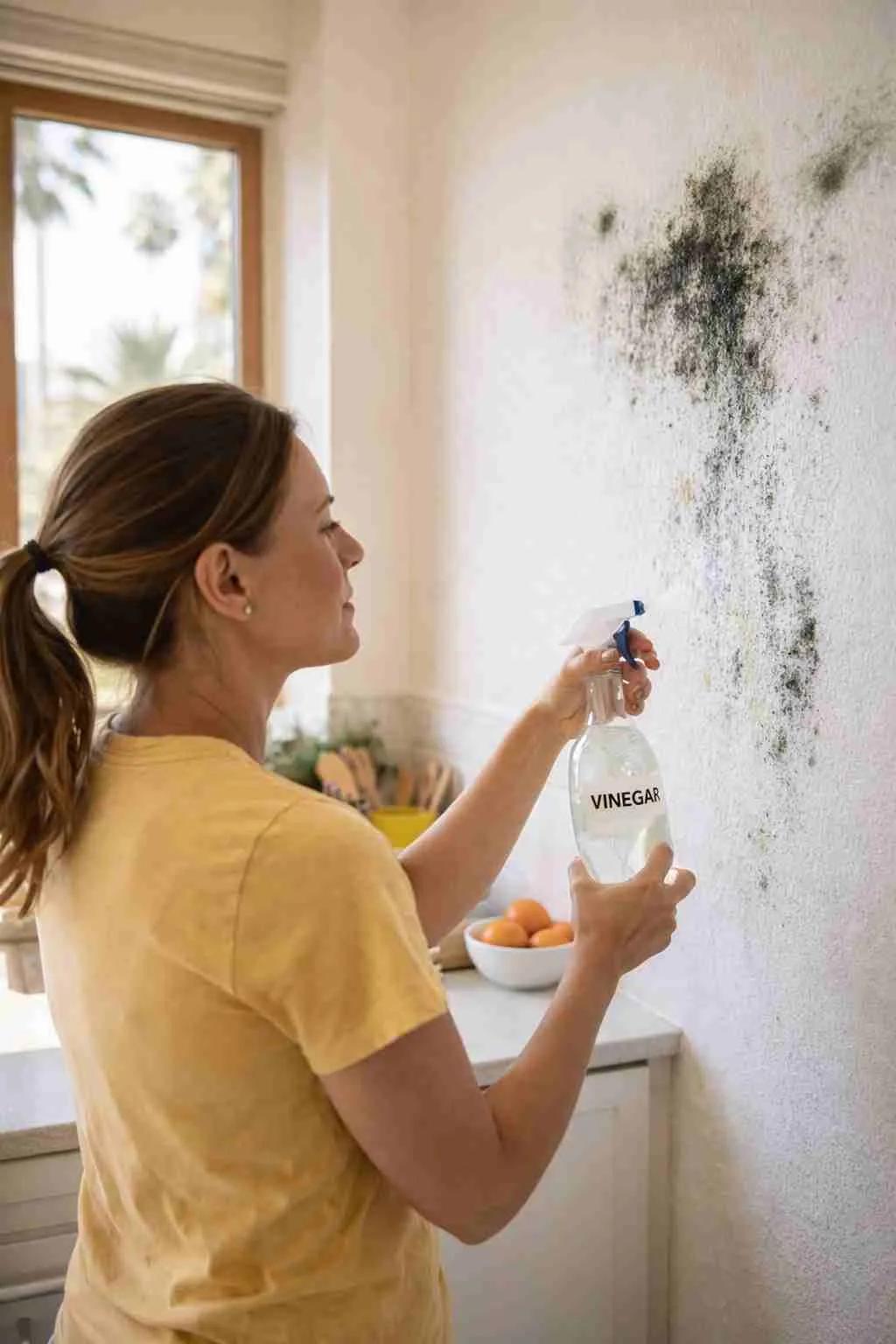
How to Clean Mold With Vinegar Safely in Your California Home
Mold can appear surprisingly quickly when moisture lingers inside a home.
In California homes, moisture problems can come from plumbing leaks, roof leaks, bathroom humidity, condensation, poor ventilation, water intrusion, or damp areas around windows and basements.
Coastal communities may also experience periods of higher humidity, but mold can develop anywhere when moisture remains long enough.
If you have discovered a small patch of mold, you may be wondering whether a common household product can help.
One of the most searched-for options is vinegar.
White vinegar can be useful for cleaning some small areas of surface mold, but it is important to understand its limitations. Vinegar is not appropriate for every material, and larger mold problems may require professional remediation rather than ordinary house cleaning.
Here is how to approach cleaning mold with vinegar safely.
Can You Clean Mold With Vinegar?
White distilled vinegar is commonly used as a household cleaner because of its acidity.
For small amounts of mold on compatible surfaces, vinegar may help loosen and reduce visible mold growth.
However, vinegar should not be treated as a universal mold-removal solution.
The U.S. Environmental Protection Agency recommends removing mold from hard surfaces with detergent and water and then drying the surface completely. The EPA also warns that mold can penetrate porous materials, making some items difficult or impossible to clean completely.
That distinction matters.
A little surface mold around a bathroom window is very different from mold spreading through drywall, insulation, carpeting, or a wall cavity.
What Type of Vinegar Should You Use for Mold?
For household cleaning, white distilled vinegar containing about 5% acetic acid is typically the most practical option.
Avoid using flavored or colored vinegars because they may leave residue or discolor surfaces.
Before putting vinegar on any surface, check whether acidic cleaners are appropriate for the material.
Vinegar can damage or dull certain surfaces, including some:
- Natural stone
- Marble
- Limestone
- Grout
- Wood finishes
- Specialty coatings
- Metal finishes
When in doubt, follow the surface manufacturer's cleaning instructions and test a small, inconspicuous area first.
How to Clean Mold With Vinegar
If the mold is limited to a small area and the surface is suitable for vinegar, you can approach the cleaning carefully.
What You'll Need
Gather:
- White distilled vinegar
- Spray bottle
- Disposable or washable cleaning cloths
- Soft cleaning brush
- Protective gloves
- Eye protection
- Appropriate respiratory protection when needed
The CDC recommends protecting your skin and eyes during mold cleanup. People with asthma, COPD, weakened immune systems, or other significant health concerns should avoid exposure to moldy environments and may need someone else to handle the cleanup.
Step 1: Find and Fix the Moisture Source
Before worrying about what kills mold, determine why the mold is growing.
Look for:
- Plumbing leaks
- Roof leaks
- Condensation
- Poor bathroom ventilation
- Water around windows
- Damp cabinets
- Previous flooding
- Persistent indoor humidity
Cleaning mold without correcting the moisture problem usually means the mold will return.
The EPA considers moisture control the key to preventing indoor mold growth.
Step 2: Determine Whether the Area Is Small Enough for DIY Cleaning
Not every mold problem should become a weekend cleaning project.
The EPA says that mold covering less than about 10 square feet can generally be handled by homeowners in many circumstances.
For larger areas, extensive water damage, contaminated water, or possible HVAC contamination, professional guidance may be appropriate.
Think of 10 square feet as roughly a 3-foot-by-3-foot area.
If mold extends behind walls or across multiple rooms, what you can see may only be part of the problem.
Step 3: Make Sure Vinegar Is Safe for the Surface
Do not automatically spray vinegar on every moldy material.
For example, mold on:
- Tile
- Certain sealed surfaces
- Some glass
- Some household fixtures
may be easier to clean than mold inside:
- Drywall
- Ceiling tiles
- Carpet
- Insulation
- Upholstery
The EPA notes that porous materials can contain mold within their spaces and crevices and sometimes need to be discarded instead of cleaned.
Step 4: Apply the Vinegar
For a compatible surface, place undiluted white distilled vinegar in a spray bottle and apply it to the affected area.
Avoid creating excessive mist or spreading material into surrounding areas.
Allow the vinegar some contact time before wiping or gently scrubbing.
There is no need to saturate walls or other building materials with large amounts of liquid. Adding unnecessary moisture to an existing mold problem can be counterproductive.
Step 5: Gently Clean the Surface
Use a cloth or soft brush to remove visible mold and residue.
Avoid aggressive dry brushing because it can disturb mold particles.
If the surface can be safely washed, cleaning the remaining residue with an appropriate detergent and water is consistent with EPA guidance for hard surfaces. US EPA
Step 6: Dry the Area Completely
This may be the most important part of the entire process.
Do not leave the surface damp.
Use ventilation and airflow where appropriate and correct whatever originally caused the moisture.
Mold requires moisture to continue growing, so cleaning without drying does not address the underlying problem.
Does Vinegar Kill Mold?
You may see online claims that vinegar kills 82% of mold species.
I would not use that statistic.
There is no need to rely on a sweeping percentage to explain why homeowners use vinegar, and mold species and surface conditions vary considerably.
A more accurate way to think about vinegar is this:
Vinegar may help clean small amounts of mold from some compatible surfaces, but it does not guarantee complete mold remediation.
For significant growth, porous materials, hidden moisture, or recurring mold, the moisture source and affected building materials need to be addressed.
Does Vinegar Kill Mold on Drywall?
Use additional caution with drywall.
Drywall is porous.
If mold is only superficial and the drywall remains structurally sound, the situation may be different from drywall that has become wet, soft, damaged, or heavily contaminated.
Because mold can penetrate porous materials, extensive moldy drywall may require removal rather than repeated surface cleaning.
If you suspect mold is inside the wall rather than simply on its surface, consider consulting a qualified mold or water-damage professional.
Does Vinegar Kill Mold on Wood?
It depends on the wood and its finish.
Finished wood, unfinished wood, engineered wood, cabinetry, and structural lumber can respond differently to moisture and acidic cleaning products.
Before using vinegar:
- Check the manufacturer's instructions
- Test a hidden area
- Avoid soaking the wood
- Dry the surface completely
- Investigate the moisture source
If mold appears to extend deeply into damaged wood, surface cleaning alone may not solve the problem.
Can You Use Vinegar on Bathroom Mold?
Bathrooms are among the most common places for small mold problems because they frequently contain moisture.
You may notice mold around:
- Shower areas
- Window frames
- Ceilings
- Caulk
- Grout
- Sink areas
Cleaning is only one part of the solution.
The EPA recommends increasing ventilation and cleaning more frequently when mold repeatedly develops in damp bathroom areas.
Use bathroom exhaust fans that vent outside when available, and allow wet surfaces to dry after bathing.
Can You Mix Vinegar and Bleach for Mold?
No. Never mix vinegar and bleach.
Mixing bleach with acidic products such as vinegar can release hazardous chlorine gas.
The CDC also warns never to mix bleach with ammonia or other cleaning products.
If you use any cleaning chemical, follow its label instructions and use adequate ventilation.
Adding more products does not necessarily make mold cleaning more effective.
Should You Mix Vinegar and Baking Soda?
You will frequently see vinegar and baking soda recommended together online.
They react when mixed, producing the familiar fizz.
However, combining them does not automatically create a stronger mold cleaner.
If you need mild abrasion on a compatible surface, baking soda may sometimes be used separately, but there is usually little reason to mix multiple household products simply because they are common DIY cleaners.
For mold, the more important priorities are:
- Removing the visible growth
- Correcting moisture
- Drying the area
- Determining whether affected material can actually be cleaned
Will Vinegar Remove Mold Stains?
Removing mold and removing discoloration are not necessarily the same thing.
Even after a surface has been cleaned, staining may remain.
The EPA notes that mold can cause cosmetic damage and that it may not always be possible to restore a material to its original appearance through cleaning alone. US EPA
Avoid repeatedly applying stronger chemicals simply because discoloration remains.
First determine whether you are looking at active mold or permanent staining.
When Should You Stop DIY Mold Cleaning?
A small mold spot is one thing.
A significant moisture problem is another.
Consider seeking qualified professional help when:
- Mold covers more than about 10 square feet
- Water damage is extensive
- Mold keeps returning after cleaning
- Drywall or other building materials are damaged
- Mold may be inside walls
- HVAC equipment may be contaminated
- The problem involves sewage or contaminated water
- Large areas of carpet or insulation are affected
- You have health concerns about mold exposure
The EPA specifically recommends additional professional consideration for large mold areas, substantial water damage, HVAC contamination, and sewage-related situations.
How to Prevent Mold From Coming Back
The best mold cleaner cannot compensate for an unresolved moisture problem.
Improve Bathroom and Kitchen Ventilation
Use exhaust fans that vent outdoors where available.
Ventilation can help reduce the moisture that supports recurring mold growth.
Repair Leaks Quickly
Inspect:
- Plumbing
- Roofs
- Windows
- Appliances
- Sinks
- Toilets
- Showers
Even a small leak can continually supply moisture to an area.
Dry Wet Areas Promptly
The EPA recommends drying wet or water-damaged areas within approximately 24 to 48 hours when possible to help prevent mold growth.
Pay Attention to Recurring Condensation
Regular condensation on windows, pipes, or walls can indicate excess moisture or temperature differences that need attention.
Keep Mold-Prone Areas Clean
Bathrooms, window areas, kitchens, and other frequently damp spaces may benefit from more frequent routine cleaning.
Don't Ignore Musty Odors
A persistent musty smell can indicate hidden moisture or mold growth even when you cannot immediately see it. The EPA recommends investigating moldy or musty odors rather than simply masking them.
Mold in California Rental Homes: What Renters Should Know
California renters have protections related to serious dampness and mold conditions, but the law is more nuanced than saying every rental must always be completely “mold-free.”
The California Department of Public Health explains that under the state's housing standards, a dwelling can be considered substandard when dampness or visible mold reaches a level that endangers occupants' health. Local code-enforcement agencies can inspect suspected housing-code violations.
If you rent and discover a significant moisture or mold problem:
- Document the condition
- Notify your landlord or property manager
- Report the moisture source as well as the visible mold
- Keep copies of communications
- Contact local code enforcement when appropriate
For specific disputes or questions about legal rights, consult the applicable California housing resources or qualified legal counsel.
Does Mold Need to Be Tested?
Homeowners sometimes assume they must identify exactly which species of mold they have before taking action.
That is usually not necessary for an ordinary visible mold problem.
The CDC does not generally recommend routine home mold testing because there are no established standards defining an acceptable amount of every type of household mold. If you can see or smell mold, the priority is usually removing it safely and fixing the moisture problem.
Is Black Mold More Dangerous?
Mold color alone does not tell you how a cleanup should be handled.
Mold can appear:
- Black
- Green
- White
- Gray
- Brown
- Orange
Rather than attempting to identify mold by appearance, focus on the extent of growth, moisture source, affected materials, and whether professional remediation is needed.
Mold Cleaning vs. Mold Remediation
These terms are not interchangeable.
Routine cleaning may be appropriate for a very small amount of surface mold on a cleanable material.
Mold remediation can involve identifying moisture sources, isolating affected areas, removing contaminated building materials, controlling airborne contamination, drying structures, and other specialized work.
This distinction is important when choosing a service provider.
A house-cleaning service should not be treated as a substitute for qualified mold remediation when structural materials or substantial areas are affected.
Where The CoBuilders Can Help
Preventing mold starts with keeping moisture-prone areas of the home clean and addressing spills, grime, and everyday buildup before they become bigger problems.
The CoBuilders connects households with professional cleaners for services such as:
- Standard house cleaning
- Deep cleaning
- Bathroom cleaning
- Kitchen cleaning
- Move-in cleaning
- Move-out cleaning
- Recurring cleaning
For significant mold growth, water-damaged building materials, contaminated HVAC systems, or structural remediation, use a qualified mold-remediation or water-damage professional.
For everyday home cleaning, you can use The CoBuilders to select the rooms you need cleaned, choose your cleaning type, review applicable pricing, and book professional cleaning online.
Frequently Asked Questions About Cleaning Mold With Vinegar
Can vinegar kill mold?
Vinegar may help clean small amounts of mold from some compatible surfaces, but it should not be treated as a universal mold-remediation solution.
What kind of vinegar should I use for mold?
White distilled vinegar is the most commonly used household option. Always confirm that acidic cleaners are safe for the material first.
Should I dilute vinegar before cleaning mold?
Many household cleaning methods use white vinegar undiluted. However, surface compatibility matters more than concentration, so follow the manufacturer's care instructions when available.
How long should vinegar sit on mold?
Allowing vinegar some contact time before cleaning can help loosen surface buildup. Avoid oversaturating walls, wood, or other moisture-sensitive materials.
Can I use vinegar on drywall mold?
Use caution. Drywall is porous, and mold that extends into the material may require removal rather than surface cleaning.
Can I mix vinegar and bleach?
No. Never mix vinegar and bleach. The combination can produce dangerous chlorine gas.
Why does mold keep coming back after I clean it?
Recurring mold usually indicates that moisture is still present.
Check for leaks, condensation, inadequate ventilation, or another continuing source of dampness.
How much mold can I clean myself?
The EPA says that mold covering less than roughly 10 square feet can often be handled by homeowners, depending on the circumstances. Larger areas or significant water damage may require professional assistance.
The Most Important Step Isn't the Vinegar
When people search for how to clean mold with vinegar, it is easy to focus entirely on the cleaning product.
But the most important part of mold control is moisture control.
Clean the affected surface when it is safe to do so.
Dry it completely.
Then find out why it became damp in the first place.
If you solve the moisture problem, you have a much better chance of keeping mold from returning.
And when the rest of your home needs attention, The CoBuilders can help you book professional house cleaning for the kitchens, bathrooms, floors, bedrooms, and living spaces that make up your everyday home.
Featured Posts
8.71 min read
Need a Recommendation for Apartment Deep Cleaning Service in Chicago?
8.97 min read
House Cleaning Services in Ventura, California
7.9 min read
House Cleaning Company Near Me: Why Austin, TX Homeowners Choose The CoBuilders

7.8 min read
Cleaning Service & House Cleaner Options in Portland, ME: Your Complete Guide
4.96 min read
Deep Cleaning of the House in San Jose, CA: When, Why & Who to Call

3.17 min read
How Do I Keep My House Clean with a Busy Schedule?

5.87 min read
What is the Difference Between Standard Cleaning and Deep Cleaning?
6.41 min read
Top House Cleaning Companies Near Me: Finding the Best Cleaning Service in the U.S.

2.85 min read
Duct Cleaning Companies Near Me in Des Moines: Why The CoBuilders Stand Out
5.84 min read
Robot Vacuum vs. Professional House Cleaning: What Can a Robot Actually Replace?